Evaluating and Refining Support Representation for Steel I-Girder Bridge Deck Placement Analysis
2023-2024, UTRGV SEED Grant (PI: Zhou)
Introduction
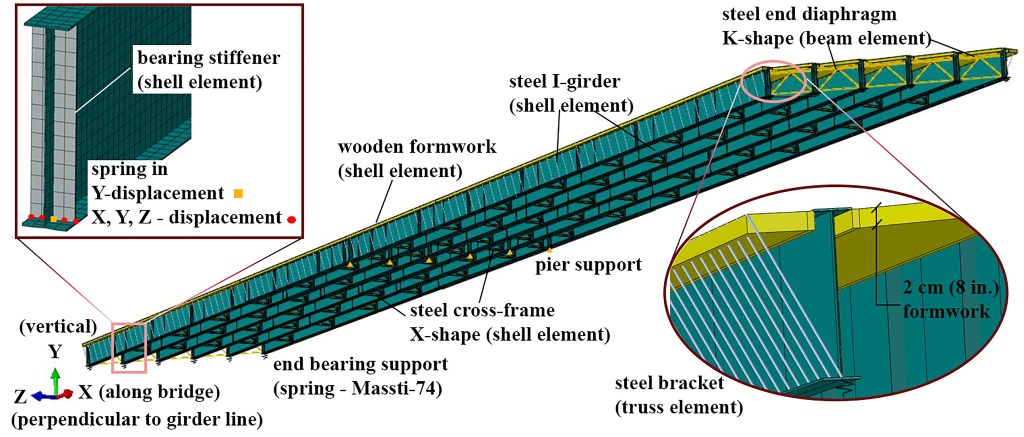
Steel I-girder bridges are are subjected to unique loading conditions during deck placement, especially when girders are not perpendicular to supports (skewed bridges). These loading conditions coupled with complex bridge geometries cannot be modeled accurately by standard 1D and traditional 2D analysis that are commonly used by bridge engineers, because of critical and not-well understood simplifications of girders, cross-frames, and supports. While detailed 3D analysis can provide rigorous representations, it is often impractical for most projects due to the prohibitive modeling complexity and computational cost. Improvements in girder and cross-frame stiffness for 2D analysis have been developed, whereas simple and unjustified idealizations remain for support representations due to the difficultly in capturing their properties realistically especially under complex construction environments. Therefore, the research aims to evaluate and refine support representation strategies for steel I-girder bridge deck placement analysis, to substantially improve numerical simulation approaches for more reliable and efficient structural design.
Publication Links
Evaluating Support Representation and Modeling Strategy for Skewed Steel I-Girder Integral Abutment Bridges during Deck Placement.
https://ascelibrary.org/doi/10.1061/JBENF2.BEENG-7379
Cross-Frame Optimization for Skewed Steel I-Girder Bridges
Introduction
Cross-frames are important load-carrying members for skewed bridge that are often designed using standardized uniform cross-sections across a bridge after considering all pertinent load cases. In lieu of traditionally-used iterative design processes that rely on engineering judgement, this research adopts algorithmic approaches to optimize cross-frame designs to as a practical, efficient, and reliable solution to refine load distribution and reduce critical bridge responses (such as flange lateral bending stress for skewed steel I-girder bridges).
Publication Links
Gradient-based algorithmic cross-frame cross-section optimization for skewed steel I-girder integral abutment bridge deck placement response.
https://doi.org/10.1016/j.engstruct.2025.120222
Explainable AI-Based Infrastructure Design
Development and Assessment of Portable Structural Testbed
Evaluation of Superstructure Response and Load Distribution in Skewed Steel I-Girder Bridges
2018-2023, a part of ICT Project R27-194 (PI: Fahnestock, Co-PI: LaFave)
Introduction
Highly-skewed steel I-girder bridges are commonly used, especially in congested areas, despite complications in their analysis, design, and construction. As part of and ICT project (R27-194), this research was conducted to establish a comprehensive understanding of load distribution in skewed steel I-girder bridges and to potentially refine the associated analysis and design procedures.
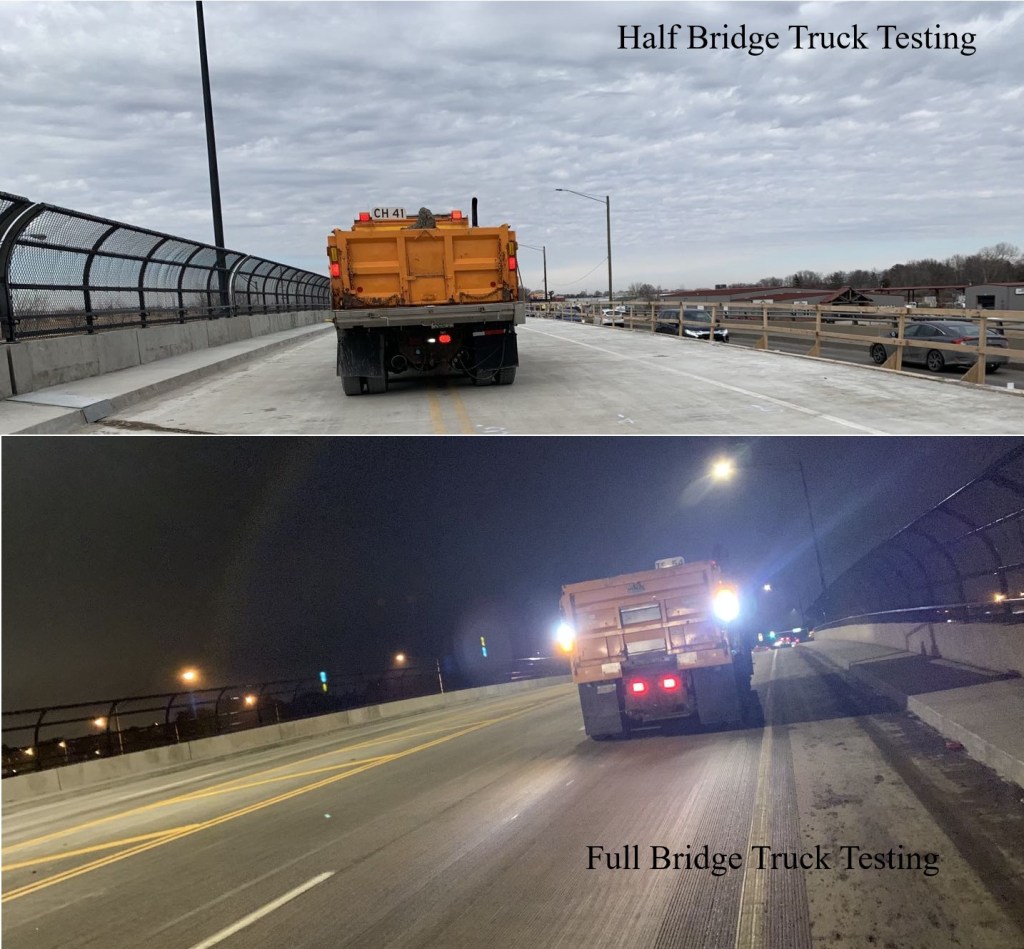
Two skewed steel I-girder bridges skewed around 45°, one with stub abutments and the other with integral abutments, were instrumented with (mainly) strain gauges on critical girder cross-sections and cross-frames in the field. Field monitoring and numerical simulations for the bridges during deck placement and under live load (through isolated truck testing) enhanced understanding of bridge behavior. Numerical parametric studies were conducted to evaluate effects of bridge geometry on skewed steel I-girder bridge superstructure response, which served as guidance to assess standard analysis and design practice.
Featured Photos


Project Links
https://cee.illinois.edu/news/bridge-monitoring-helping-rebuild-illinois
Publication Links
Field and Numerical Evaluations of Static and Dynamic Live Load Response in Skewed Steel I-Girder Bridges with Stub and Integral Abutments.
https://doi.org/10.1061/JBENF2.BEENG-6767
Parametric Study of Skewed Steel I-Girder Bridge Truck Live Load Response.
https://ascelibrary.org/doi/10.1061/JBENF2/BEENG-6854
Long-Term Field Response of Skewed Steel I-Girder Bridge Superstructures under Thermal Variation.
https://ascelibrary.org/doi/10.1061/JPCFEV.CFENG-4612
Field and Numerical Evaluation of Lateral Bending in Skewed Steel I-Girder Bridges during Deck Placement.
https://ascelibrary.org/doi/10.1061/JBENF2.BEENG-6292
Development of Skewed Steel I-Girder Bridge Field Monitoring Strategy through Agency Survey and Numerical Simulation.
https://doi.org/10.1061/(ASCE)SC.1943-5576.0000740
Construction and Live Load Behavior of a Skewed Steel I-Girder Bridge.
https://doi.org/10.1177/03611981221105276
Initial Field Response and Modeling of Two Skewed Steel I-Girder Bridges.
http://eswp.com/product/ibc-21-reserve-zhou
 Siang Zhou Research Group